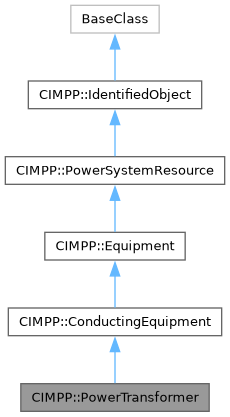
An electrical device consisting of two or more coupled windings, with or without a magnetic core, for introducing mutual coupling between electric circuits. Transformers can be used to control voltage and phase shift (active power flow). A power transformer may be composed of separate transformer tanks that need not be identical. A power transformer can be modelled with or without tanks and is intended for use in both balanced and unbalanced representations. A power transformer typically has two terminals, but may have one (grounding), three or more terminals. The inherited association ConductingEquipment.BaseVoltage should not be used. The association from TransformerEnd to BaseVoltage should be used instead.
More...
|
|
static void | addConstructToMap (std::unordered_map< std::string, BaseClass *(*)()> &factory_map) |
|
static void | addPrimitiveAssignFnsToMap (std::unordered_map< std::string, assign_function > &assign_map) |
|
static void | addClassAssignFnsToMap (std::unordered_map< std::string, class_assign_function > &assign_map) |
|
static const BaseClassDefiner | declare () |
|
static void | addConstructToMap (std::unordered_map< std::string, BaseClass *(*)()> &factory_map) |
|
static void | addPrimitiveAssignFnsToMap (std::unordered_map< std::string, assign_function > &assign_map) |
|
static void | addClassAssignFnsToMap (std::unordered_map< std::string, class_assign_function > &assign_map) |
|
static const CIMPP::BaseClassDefiner | declare () |
|
|
std::list< CIMPP::PowerTransformerEnd * > | PowerTransformerEnd |
| | The ends of this power transformer. Default: {}.
|
|
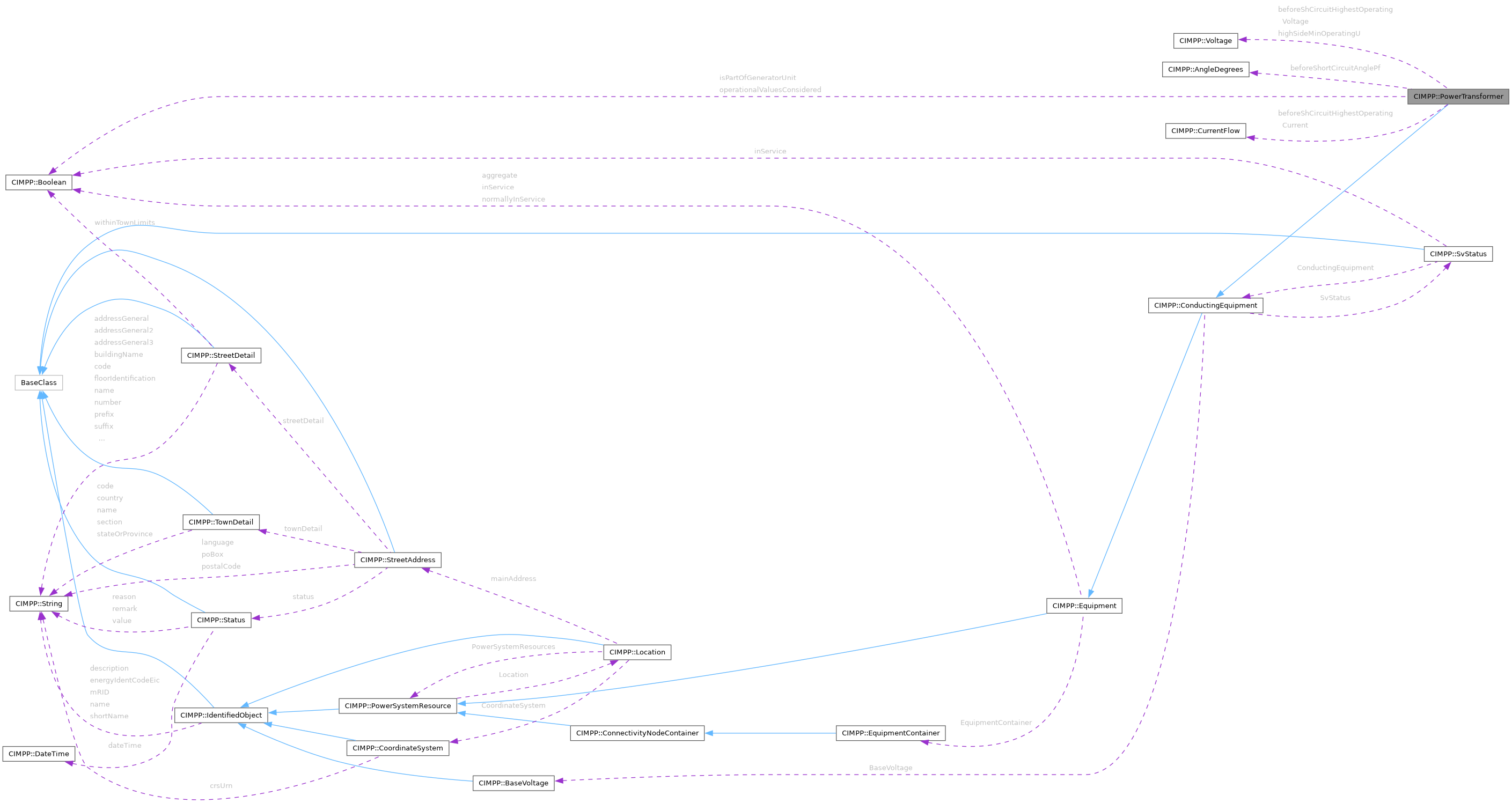
CIMPP::CurrentFlow | beforeShCircuitHighestOperatingCurrent |
| | The highest operating current (Ib in IEC 60909-0) before short circuit (depends on network configuration and relevant reliability philosophy). It is used for calculation of the impedance correction factor KT defined in IEC 60909-0. Default: 0.0.
|
|
CIMPP::Voltage | beforeShCircuitHighestOperatingVoltage |
| | The highest operating voltage (Ub in IEC 60909-0) before short circuit. It is used for calculation of the impedance correction factor KT defined in IEC 60909-0. This is worst case voltage on the low side winding (3.7.1 of IEC 60909:2001). Used to define operating conditions. Default: 0.0.
|
|
CIMPP::AngleDegrees | beforeShortCircuitAnglePf |
| | The angle of power factor before short circuit (phib in IEC 60909-0). It is used for calculation of the impedance correction factor KT defined in IEC 60909-0. This is the worst case power factor. Used to define operating conditions. Default: 0.0.
|
|
CIMPP::Voltage | highSideMinOperatingU |
| | The minimum operating voltage (uQmin in IEC 60909-0) at the high voltage side (Q side) of the unit transformer of the power station unit. A value well established from long-term operating experience of the system. It is used for calculation of the impedance correction factor KG defined in IEC 60909-0. Default: 0.0.
|
|
CIMPP::Boolean | isPartOfGeneratorUnit |
| | Indicates whether the machine is part of a power station unit. Used for short circuit data exchange according to IEC 60909. It has an impact on how the correction factors are calculated for transformers, since the transformer is not necessarily part of a synchronous machine and generating unit. It is not always possible to derive this information from the model. This is why the attribute is necessary. Default: false.
|
|
CIMPP::Boolean | operationalValuesConsidered |
| | It is used to define if the data (other attributes related to short circuit data exchange) defines long term operational conditions or not. Used for short circuit data exchange according to IEC 60909. Default: false.
|
|
CIMPP::BaseVoltage * | BaseVoltage |
| | Base voltage of this conducting equipment. Use only when there is no voltage level container used and only one base voltage applies. For example, not used for transformers. Default: nullptr.
|
|
CIMPP::SvStatus * | SvStatus |
| | The status state variable associated with this conducting equipment. Default: nullptr.
|
|
std::list< CIMPP::Terminal * > | Terminals |
| | Conducting equipment have terminals that may be connected to other conducting equipment terminals via connectivity nodes or topological nodes. Default: {}.
|
|
CIMPP::EquipmentContainer * | EquipmentContainer |
| | Container of this equipment. Default: nullptr.
|
|
std::list< CIMPP::OperationalLimitSet * > | OperationalLimitSet |
| | The operational limit sets associated with this equipment. Default: {}.
|
|
CIMPP::Boolean | aggregate |
| | The aggregate flag provides an alternative way of representing an aggregated (equivalent) element. It is applicable in cases when the dedicated classes for equivalent equipment do not have all of the attributes necessary to represent the required level of detail. In case the flag is set to true the single instance of equipment represents multiple pieces of equipment that have been modelled together as an aggregate equivalent obtained by a network reduction procedure. Examples would be power transformers or synchronous machines operating in parallel modelled as a single aggregate power transformer or aggregate synchronous machine. The attribute is not used for EquivalentBranch, EquivalentShunt and EquivalentInjection. Default: false.
|
|
CIMPP::Boolean | inService |
| | Specifies the availability of the equipment. True means the equipment is available for topology processing, which determines if the equipment is energized or not. False means that the equipment is treated by network applications as if it is not in the model. Default: false.
|
|
CIMPP::Boolean | normallyInService |
| | Specifies the availability of the equipment under normal operating conditions. True means the equipment is available for topology processing, which determines if the equipment is energized or not. False means that the equipment is treated by network applications as if it is not in the model. Default: false.
|
|
std::list< CIMPP::Control * > | Controls |
| | The controller outputs used to actually govern a regulating device, e.g. the magnetization of a synchronous machine or capacitor bank breaker actuator. Default: {}.
|
|
CIMPP::Location * | Location |
| | Location of this power system resource. Default: nullptr.
|
|
std::list< CIMPP::Measurement * > | Measurements |
| | The measurements associated with this power system resource. Default: {}.
|
|
std::list< CIMPP::DiagramObject * > | DiagramObjects |
| | The diagram objects that are associated with the domain object. Default: {}.
|
|
CIMPP::String | description |
| | The description is a free human readable text describing or naming the object. It may be non unique and may not correlate to a naming hierarchy. Default: "".
|
|
CIMPP::String | energyIdentCodeEic |
| | The attribute is used for an exchange of the EIC code (Energy identification Code). The length of the string is 16 characters as defined by the EIC code. For details on EIC scheme please refer to ENTSO-E web site. Default: "".
|
|
CIMPP::String | mRID |
| | Master resource identifier issued by a model authority. The mRID is unique within an exchange context. Global uniqueness is easily achieved by using a UUID, as specified in RFC 4122, for the mRID. The use of UUID is strongly recommended. For CIMXML data files in RDF syntax conforming to IEC 61970-552, the mRID is mapped to rdf:ID or rdf:about attributes that identify CIM object elements. Default: "".
|
|
CIMPP::String | name |
| | The name is any free human readable and possibly non unique text naming the object. Default: "".
|
|
CIMPP::String | shortName |
| | The attribute is used for an exchange of a human readable short name with length of the string 12 characters maximum. Default: "".
|
An electrical device consisting of two or more coupled windings, with or without a magnetic core, for introducing mutual coupling between electric circuits. Transformers can be used to control voltage and phase shift (active power flow). A power transformer may be composed of separate transformer tanks that need not be identical. A power transformer can be modelled with or without tanks and is intended for use in both balanced and unbalanced representations. A power transformer typically has two terminals, but may have one (grounding), three or more terminals. The inherited association ConductingEquipment.BaseVoltage should not be used. The association from TransformerEnd to BaseVoltage should be used instead.

 1.15.0