A control area is a grouping of generating units and/or loads and a cutset of tie lines (as terminals) which may be used for a variety of purposes including automatic generation control, power flow solution area interchange control specification, and input to load forecasting. All generation and load within the area defined by the terminals on the border are considered in the area interchange control. Note that any number of overlapping control area specifications can be superimposed on the physical model. The following general principles apply to ControlArea: 1. The control area orientation for net interchange is positive for an import, negative for an export. 2. The control area net interchange is determined by summing flows in Terminals. The Terminals are identified by creating a set of TieFlow objects associated with a ControlArea object. Each TieFlow object identifies one Terminal. 3. In a single network model, a tie between two control areas must be modelled in both control area specifications, such that the two representations of the tie flow sum to zero. 4. The normal orientation of Terminal flow is positive for flow into the conducting equipment that owns the Terminal. (i.e. flow from a bus into a device is positive.) However, the orientation of each flow in the control area specification must align with the control area convention, i.e. import is positive. If the orientation of the Terminal flow referenced by a TieFlow is positive into the control area, then this is confirmed by setting TieFlow.positiveFlowIn flag TRUE. If not, the orientation must be reversed by setting the TieFlow.positiveFlowIn flag FALSE.
More...
#include <ControlArea.hpp>
|
|
static void | addConstructToMap (std::unordered_map< std::string, BaseClass *(*)()> &factory_map) |
|
static void | addPrimitiveAssignFnsToMap (std::unordered_map< std::string, assign_function > &assign_map) |
|
static void | addClassAssignFnsToMap (std::unordered_map< std::string, class_assign_function > &assign_map) |
|
static const BaseClassDefiner | declare () |
|
static void | addConstructToMap (std::unordered_map< std::string, BaseClass *(*)()> &factory_map) |
|
static void | addPrimitiveAssignFnsToMap (std::unordered_map< std::string, assign_function > &assign_map) |
|
static void | addClassAssignFnsToMap (std::unordered_map< std::string, class_assign_function > &assign_map) |
|
static const CIMPP::BaseClassDefiner | declare () |
|
|
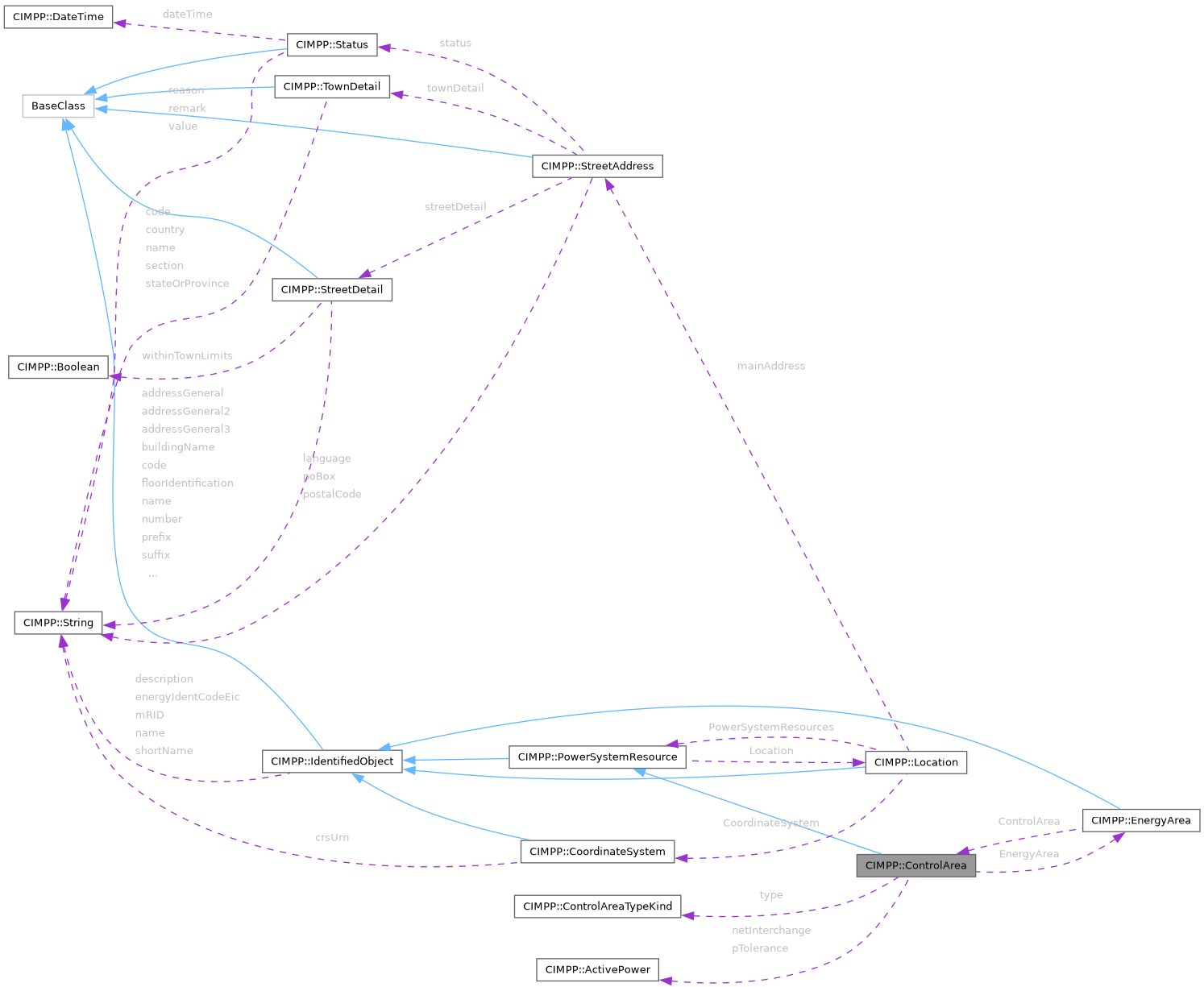
std::list< CIMPP::ControlAreaGeneratingUnit * > | ControlAreaGeneratingUnit |
| | The generating unit specifications for the control area. Default: {}.
|
|
CIMPP::EnergyArea * | EnergyArea |
| | The energy area that is forecast from this control area specification. Default: nullptr.
|
|
std::list< CIMPP::TieFlow * > | TieFlow |
| | The tie flows associated with the control area. Default: {}.
|
|
CIMPP::ActivePower | netInterchange |
| | The specified positive net interchange into the control area, i.e. positive sign means flow into the area. Default: 0.0.
|
|
CIMPP::ActivePower | pTolerance |
| | Active power net interchange tolerance. The attribute shall be a positive value or zero. Default: 0.0.
|
|
CIMPP::ControlAreaTypeKind | type |
| | The primary type of control area definition used to determine if this is used for automatic generation control, for planning interchange control, or other purposes. A control area specified with primary type of automatic generation control could still be forecast and used as an interchange area in power flow analysis. Default: 0.
|
|
std::list< CIMPP::Control * > | Controls |
| | The controller outputs used to actually govern a regulating device, e.g. the magnetization of a synchronous machine or capacitor bank breaker actuator. Default: {}.
|
|
CIMPP::Location * | Location |
| | Location of this power system resource. Default: nullptr.
|
|
std::list< CIMPP::Measurement * > | Measurements |
| | The measurements associated with this power system resource. Default: {}.
|
|
std::list< CIMPP::DiagramObject * > | DiagramObjects |
| | The diagram objects that are associated with the domain object. Default: {}.
|
|
CIMPP::String | description |
| | The description is a free human readable text describing or naming the object. It may be non unique and may not correlate to a naming hierarchy. Default: "".
|
|
CIMPP::String | energyIdentCodeEic |
| | The attribute is used for an exchange of the EIC code (Energy identification Code). The length of the string is 16 characters as defined by the EIC code. For details on EIC scheme please refer to ENTSO-E web site. Default: "".
|
|
CIMPP::String | mRID |
| | Master resource identifier issued by a model authority. The mRID is unique within an exchange context. Global uniqueness is easily achieved by using a UUID, as specified in RFC 4122, for the mRID. The use of UUID is strongly recommended. For CIMXML data files in RDF syntax conforming to IEC 61970-552, the mRID is mapped to rdf:ID or rdf:about attributes that identify CIM object elements. Default: "".
|
|
CIMPP::String | name |
| | The name is any free human readable and possibly non unique text naming the object. Default: "".
|
|
CIMPP::String | shortName |
| | The attribute is used for an exchange of a human readable short name with length of the string 12 characters maximum. Default: "".
|
|
|
static const char | debugName [] = "ControlArea" |
|
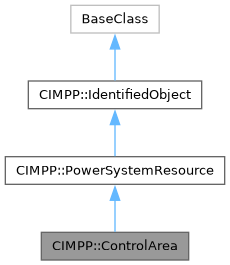
static const char | debugName [] = "PowerSystemResource" |
|
static const char | debugName [] = "IdentifiedObject" |
|
static const char | debugName [] = "BaseClass" |
A control area is a grouping of generating units and/or loads and a cutset of tie lines (as terminals) which may be used for a variety of purposes including automatic generation control, power flow solution area interchange control specification, and input to load forecasting. All generation and load within the area defined by the terminals on the border are considered in the area interchange control. Note that any number of overlapping control area specifications can be superimposed on the physical model. The following general principles apply to ControlArea: 1. The control area orientation for net interchange is positive for an import, negative for an export. 2. The control area net interchange is determined by summing flows in Terminals. The Terminals are identified by creating a set of TieFlow objects associated with a ControlArea object. Each TieFlow object identifies one Terminal. 3. In a single network model, a tie between two control areas must be modelled in both control area specifications, such that the two representations of the tie flow sum to zero. 4. The normal orientation of Terminal flow is positive for flow into the conducting equipment that owns the Terminal. (i.e. flow from a bus into a device is positive.) However, the orientation of each flow in the control area specification must align with the control area convention, i.e. import is positive. If the orientation of the Terminal flow referenced by a TieFlow is positive into the control area, then this is confirmed by setting TieFlow.positiveFlowIn flag TRUE. If not, the orientation must be reversed by setting the TieFlow.positiveFlowIn flag FALSE.
◆ addClassGetFnsToMap()
| void ControlArea::addClassGetFnsToMap |
( |
std::map< std::string, class_get_function > & | get_map | ) |
const |
|
overridevirtual |
◆ addEnumGetFnsToMap()
| void ControlArea::addEnumGetFnsToMap |
( |
std::map< std::string, get_function > & | get_map | ) |
const |
|
overridevirtual |
◆ addPrimitiveGetFnsToMap()
| void ControlArea::addPrimitiveGetFnsToMap |
( |
std::map< std::string, get_function > & | get_map | ) |
const |
|
overridevirtual |
◆ allAttrDetailsMap()
| std::map< std::string, AttrDetails > ControlArea::allAttrDetailsMap |
( |
| ) |
const |
|
overrideprotectedvirtual |
◆ debugString()
| const char * ControlArea::debugString |
( |
| ) |
const |
|
overridevirtual |
◆ getAttributeNames()
| const std::list< std::string > & ControlArea::getAttributeNames |
( |
| ) |
const |
|
overridevirtual |
◆ getAttributeNamespaceUrl()
| const std::string & ControlArea::getAttributeNamespaceUrl |
( |
const std::string & | attrName | ) |
const |
|
overridevirtual |
◆ getClassNamespaceUrl()
| const std::string & ControlArea::getClassNamespaceUrl |
( |
| ) |
const |
|
overridevirtual |
◆ getPossibleAttributeProfiles()
| const std::list< CGMESProfile > & ControlArea::getPossibleAttributeProfiles |
( |
const std::string & | attrName | ) |
const |
|
overridevirtual |
◆ getPossibleProfiles()
| const std::list< CGMESProfile > & ControlArea::getPossibleProfiles |
( |
| ) |
const |
|
overridevirtual |
◆ getPossibleProfilesIncludingAttributes()
| const std::list< CGMESProfile > & ControlArea::getPossibleProfilesIncludingAttributes |
( |
| ) |
const |
|
overridevirtual |
◆ getRecommendedProfile()
| const CGMESProfile & ControlArea::getRecommendedProfile |
( |
| ) |
const |
|
overridevirtual |
◆ isAssignableFrom()
| bool ControlArea::isAssignableFrom |
( |
BaseClass * | otherObject | ) |
const |
|
overridevirtual |
The documentation for this class was generated from the following files:

 1.15.0