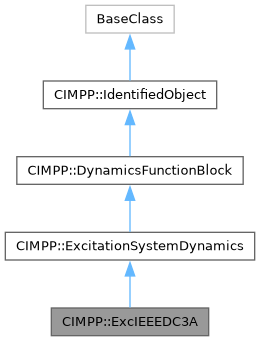
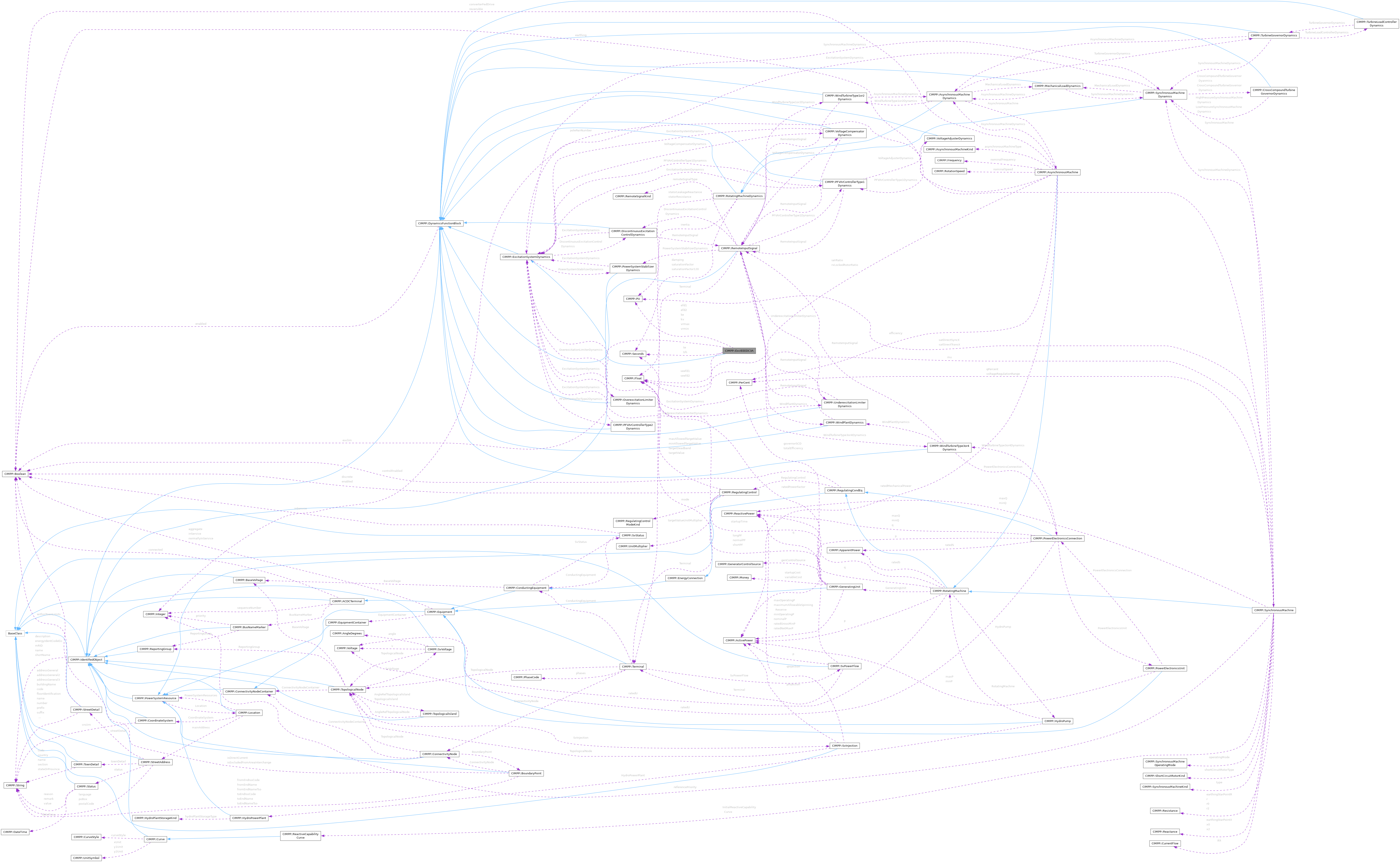
IEEE 421.5-2005 type DC3A model. This model represents older systems, in particular those DC commutator exciters with non-continuously acting regulators that were commonly used before the development of the continuously acting varieties. These systems respond at basically two different rates, depending upon the magnitude of voltage error. For small errors, adjustment is made periodically with a signal to a motor-operated rheostat. Larger errors cause resistors to be quickly shorted or inserted and a strong forcing signal applied to the exciter. Continuous motion of the motor-operated rheostat occurs for these larger error signals, even though it is bypassed by contactor action. Reference: IEEE 421.5-2005, 5.3.
More...
|
|
static void | addConstructToMap (std::unordered_map< std::string, BaseClass *(*)()> &factory_map) |
|
static void | addPrimitiveAssignFnsToMap (std::unordered_map< std::string, assign_function > &assign_map) |
|
static void | addClassAssignFnsToMap (std::unordered_map< std::string, class_assign_function > &assign_map) |
|
static const BaseClassDefiner | declare () |
|
static void | addConstructToMap (std::unordered_map< std::string, BaseClass *(*)()> &factory_map) |
|
static void | addPrimitiveAssignFnsToMap (std::unordered_map< std::string, assign_function > &assign_map) |
|
static void | addClassAssignFnsToMap (std::unordered_map< std::string, class_assign_function > &assign_map) |
|
static const BaseClassDefiner | declare () |
|
static void | addConstructToMap (std::unordered_map< std::string, BaseClass *(*)()> &factory_map) |
|
static void | addPrimitiveAssignFnsToMap (std::unordered_map< std::string, assign_function > &assign_map) |
|
static void | addClassAssignFnsToMap (std::unordered_map< std::string, class_assign_function > &assign_map) |
|
static const BaseClassDefiner | declare () |
|
static void | addConstructToMap (std::unordered_map< std::string, BaseClass *(*)()> &factory_map) |
|
static void | addPrimitiveAssignFnsToMap (std::unordered_map< std::string, assign_function > &assign_map) |
|
static void | addClassAssignFnsToMap (std::unordered_map< std::string, class_assign_function > &assign_map) |
|
static const BaseClassDefiner | declare () |
|
static void | addConstructToMap (std::unordered_map< std::string, BaseClass *(*)()> &factory_map) |
|
static void | addPrimitiveAssignFnsToMap (std::unordered_map< std::string, assign_function > &assign_map) |
|
static void | addClassAssignFnsToMap (std::unordered_map< std::string, class_assign_function > &assign_map) |
|
static const CIMPP::BaseClassDefiner | declare () |
|
|
CIMPP::PU | efd1 |
| | Exciter voltage at which exciter saturation is defined (EFD1) (> 0). Typical value = 3,375. Default: 0.0.
|
|
CIMPP::PU | efd2 |
| | Exciter voltage at which exciter saturation is defined (EFD2) (> 0). Typical value = 3,15. Default: 0.0.
|
|
CIMPP::Boolean | exclim |
| | (exclim). IEEE standard is ambiguous about lower limit on exciter output. true = a lower limit of zero is applied to integrator output false = a lower limit of zero is not applied to integrator output. Typical value = true. Default: false
|
|
CIMPP::PU | ke |
| | Exciter constant related to self-excited field (KE). Typical value = 0,05. Default: 0.0.
|
|
CIMPP::PU | kv |
| | Fast raise/lower contact setting (KV) (> 0). Typical value = 0,05. Default: 0.0.
|
|
CIMPP::Float | seefd1 |
| | Exciter saturation function value at the corresponding exciter voltage, EFD1 (SE[EFD1]) (>= 0). Typical value = 0,267. Default: 0.0.
|
|
CIMPP::Float | seefd2 |
| | Exciter saturation function value at the corresponding exciter voltage, EFD2 (SE[EFD2]) (>= 0). Typical value = 0,068. Default: 0.0.
|
|
CIMPP::Seconds | te |
| | Exciter time constant, integration rate associated with exciter control (TE) (> 0). Typical value = 0,5. Default: 0.0.
|
|
CIMPP::Seconds | trh |
| | Rheostat travel time (TRH) (> 0). Typical value = 20. Default: 0.0.
|
|
CIMPP::PU | vrmax |
| | Maximum voltage regulator output (VRMAX) (> 0). Typical value = 1. Default: 0.0.
|
|
CIMPP::PU | vrmin |
| | Minimum voltage regulator output (VRMIN) (<= 0). Typical value = 0. Default: 0.0.
|
|
CIMPP::DiscontinuousExcitationControlDynamics * | DiscontinuousExcitationControlDynamics |
| | Discontinuous excitation control model associated with this excitation system model. Default: nullptr.
|
|
CIMPP::OverexcitationLimiterDynamics * | OverexcitationLimiterDynamics |
| | Overexcitation limiter model associated with this excitation system model. Default: nullptr.
|
|
CIMPP::PFVArControllerType1Dynamics * | PFVArControllerType1Dynamics |
| | Power factor or VAr controller type 1 model associated with this excitation system model. Default: nullptr.
|
|
CIMPP::PFVArControllerType2Dynamics * | PFVArControllerType2Dynamics |
| | Power factor or VAr controller type 2 model associated with this excitation system model. Default: nullptr.
|
|
CIMPP::PowerSystemStabilizerDynamics * | PowerSystemStabilizerDynamics |
| | Power system stabilizer model associated with this excitation system model. Default: nullptr.
|
|
CIMPP::SynchronousMachineDynamics * | SynchronousMachineDynamics |
| | Synchronous machine model with which this excitation system model is associated. Default: nullptr.
|
|
CIMPP::UnderexcitationLimiterDynamics * | UnderexcitationLimiterDynamics |
| | Undrexcitation limiter model associated with this excitation system model. Default: nullptr.
|
|
CIMPP::VoltageCompensatorDynamics * | VoltageCompensatorDynamics |
| | Voltage compensator model associated with this excitation system model. Default: nullptr.
|
|
CIMPP::Boolean | enabled |
| | Function block used indicator. true = use of function block is enabled false = use of function block is disabled. Default: false.
|
|
std::list< CIMPP::DiagramObject * > | DiagramObjects |
| | The diagram objects that are associated with the domain object. Default: {}.
|
|
CIMPP::String | description |
| | The description is a free human readable text describing or naming the object. It may be non unique and may not correlate to a naming hierarchy. Default: "".
|
|
CIMPP::String | energyIdentCodeEic |
| | The attribute is used for an exchange of the EIC code (Energy identification Code). The length of the string is 16 characters as defined by the EIC code. For details on EIC scheme please refer to ENTSO-E web site. Default: "".
|
|
CIMPP::String | mRID |
| | Master resource identifier issued by a model authority. The mRID is unique within an exchange context. Global uniqueness is easily achieved by using a UUID, as specified in RFC 4122, for the mRID. The use of UUID is strongly recommended. For CIMXML data files in RDF syntax conforming to IEC 61970-552, the mRID is mapped to rdf:ID or rdf:about attributes that identify CIM object elements. Default: "".
|
|
CIMPP::String | name |
| | The name is any free human readable and possibly non unique text naming the object. Default: "".
|
|
CIMPP::String | shortName |
| | The attribute is used for an exchange of a human readable short name with length of the string 12 characters maximum. Default: "".
|
IEEE 421.5-2005 type DC3A model. This model represents older systems, in particular those DC commutator exciters with non-continuously acting regulators that were commonly used before the development of the continuously acting varieties. These systems respond at basically two different rates, depending upon the magnitude of voltage error. For small errors, adjustment is made periodically with a signal to a motor-operated rheostat. Larger errors cause resistors to be quickly shorted or inserted and a strong forcing signal applied to the exciter. Continuous motion of the motor-operated rheostat occurs for these larger error signals, even though it is bypassed by contactor action. Reference: IEEE 421.5-2005, 5.3.

 1.15.0